
Home >> Interaction Patterns

The characteristics that lead to Autism Spectrum Disorder and affect social interaction include difficulty in recognizing social cues and knowing when to talk or listen, as well as facial expressions that are hard to read, which can result in social isolation.
Below are some patterns of language use and behaviors that are often found in children with autism spectrum disorder
Children with autism spectrum disorder often say things that don’t make sense or aren’t related to conversations they’re having with others. For example, a child might repeatedly count from one to five times during a conversation that isn’t about numbers. Or, a child might constantly repeat words they’ve heard, a condition called echolalia. Echolalia occurs when a child repeats words that someone has just said. For example, a child might respond to a question by asking the same question. Another condition, called delayed echolalia, is when a child repeats words heard earlier. Some children with autism spectrum disorder speak in a high-pitched voice, sing a song, or use robotic-like speech. Other children use phrases to start a conversation. For example, a child might say, “My name is Tom,” to start talking to friends or family.
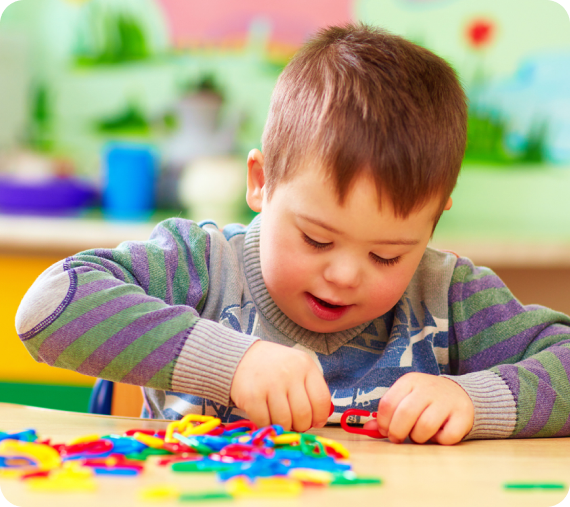

Some children are able to have an in-depth individual conversation about a topic that interests them, although they may not be able to have a two-way conversation about the same topic. Others have musical talents or advanced ability in math calculations.
Children with autism spectrum disorder have some speech and language skills, but they are not at the normal level, and their progress is often uneven. A child with autism may be able to read words before the age of five but may not understand what they read. A child with autism typically does not respond to speech from others and may not respond to their name. As a result, these children are sometimes thought to have a hearing problem.
Atlas Center for Autism. All rights reserved 2025 ©

